

Core of a cross-section#
- Core of cross-section#
A centre of force within the core corresponds with a stress distribution in the cross-section that does not exhibit a change in sign.
This is treated in chapter 4.9 and 9.15.1 of the book Engineering Mechanics Volume 2 (Hartsuijker and Welleman, 2007). Chapter 9 is not part of the Dutch version but can be found chapter 1.5 of Niet-symmetrische en inhomogene doorsnedes (Hartsuijker and Welleman, 2009).
To find the complete core of a cross-section the method is treated for nonsymmetrical cross-sections in chapter 9.15.2 of the book Engineering Mechanics Volume 2 (Hartsuijker and Welleman, 2007). For symmetrical cross-sections the following relations simplify:
Equation 9.40 transforms into two independent equations: \(M_y = EI_{yy} \cdot \kappa_y\) and \(M_z = EI_{zz} \cdot \kappa_z\)
Equation 9.75 transforms into two independent equations: \(e_y = -\cfrac{I_{yy}}{A \cdot y_1}\) and \(e_z = -\cfrac{I_{zz}}{A \cdot z_1}\)
Example complete core of a symmetrical cross-section#
Give is the following cross-section:
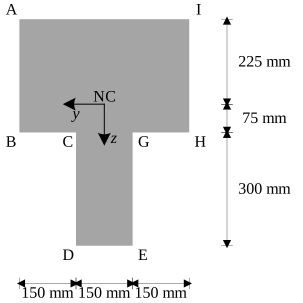
with:
\(A = 180000 \ \rm{ mm}^2\)
\(I_{zz} = 4.134375 \cdot 10^9 \ \rm{ mm}^4\)
\(I_{yy} = 2.3625 \cdot 10^9 \ \rm{ mm}^4\)
The core is defined by the neutral axes along the sides of the cross-section: side \(\rm{AI}\), \(\rm{IH}\), \(\rm{EH}\), \(\rm{DE}\) and symmetrical \(\rm{BD}\) and \(\rm{AB}\).
Side \(\rm{AI}\)#
For \(\rm{AI}\), \(y_1 = \infty\) and \(z_1 = -225 \ rm{ mm}\):
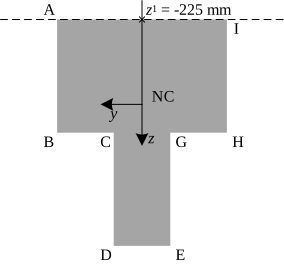
This results in:
\(e_y = -\cfrac{2.3625 \cdot 10^9 }{180000 \cdot \infty} = 0 \ \rm{ mm}\)
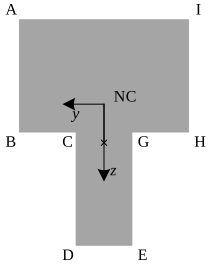
\(e_z = -\cfrac{4.134375 \cdot 10^9}{180000 \cdot -225} \approx 102 \ \rm{ mm} \)
This gives the first core point:
Side \(\rm{IH}\)#
For \(\rm{IH}\), \(y_1 = -225 \ \rm{ mm}\) and \(z_1 = \infty\). This results in:
\(e_y = -\cfrac{2.3625 \cdot 10^9 }{180000 \cdot -225} \approx 58 \ \rm{ mm}\)
\(e_z = -\cfrac{4.134375 \cdot 10^9}{180000 \cdot \infty} = 0 \ \rm{ mm}\)
Side \(\rm{EH}\)#
For \(\rm{EH}\), \(y_1\) and \(z_1\) can not directly be found from the figure, but need to be calculated. The points \(\rm{E } \left(-75,375\right)\) and \(\rm{H }\left(-225,75\right)\) are known, giving the equation for the neutral axis: \(z = 2 \cdot y + 525\). This gives \(y_1 = -262.5 \ \rm{ mm}\) and \(z_1 = 525 \ \rm{ mm}\).
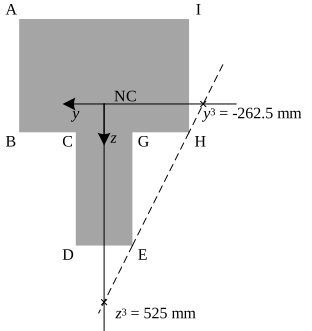
This results in:
\(e_y = -\cfrac{2.3625 \cdot 10^9 }{180000 \cdot -262.5} = 50\ \rm{ mm}\)
\(e_z = -\cfrac{4.134375 \cdot 10^9}{180000 \cdot 525} = -43.75 \ \rm{ mm} \)
Side \(\rm{DE}\)#
For \(\rm{IH}\), \(y_1 = \infty\) and \(z_1 = 375 \ \rm{ mm}\). This results in:
\(e_y = -\cfrac{2.3625 \cdot 10^9 }{180000 \cdot \infty} = 0 \ \rm{ mm}\)
\(e_z = -\cfrac{4.134375 \cdot 10^9}{180000 \cdot 375} = -61.25 \ \rm{ mm}\)
Side \(\rm{DB}\)#
Side \(\rm{DB}\) is the mirror neutral axis and core point from \(\rm{EH}\) giving:
\(e_y = -50 \ \rm{ mm}\)
\(e_z = -43.75 \ \rm{ mm} \)
Side \(\rm{AB}\)#
Side \(\rm{AB}\) is the mirror neutral axis and core point from \(\rm{HI}\) giving:
\(e_y \approx -58 \ \rm{ mm}\)
\(e_z = 0 \ \rm{ mm} \)
Core#
All these points result in the core:
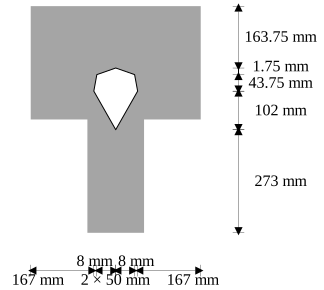
Instructions from lecture#
This topic is presented in Dutch in a lecture available from 1:02:50 - 1:53:00 here and from 0:02:40 - 0:31:30 here.
Exercises#
Exercises 4.65-4.72, in chapter 4.14 of the book Engineering Mechanics Volume 2 (Hartsuijker and Welleman, 2007). Answers are available on this website.
Exercise 9.31:1-2, 9.32:1, 9.33:2 in chapter 9.18 of the book Engineering Mechanics Volume 2 (Hartsuijker and Welleman, 2007).
Vraagstuk 5 in chapter 2.6 of the book Niet-symmetrische en inhomogene doorsnedes (Hartsuijker and Welleman, 2009). Answers available here