

import matplotlib
if not hasattr(matplotlib.RcParams, "_get"):
    matplotlib.RcParams._get = dict.get
Opgave 1#
Gegeven is de volgende constructie:
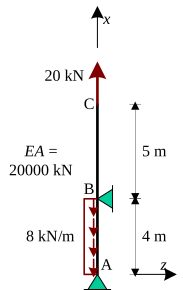
Fig. 224 #
Vind het maximale moment en de maximale doorzakking, inclusief de locaties van deze maxima.
Opgave
Maak de opdracht in WebLab. Heb je nog geen toegang? Schrijf je dan eerst hier in voor dit vak op WebLab.
Je kan je antwoord op de vragen in de volgende opgaves invoeren. Maar om je code te checken klik je op ‘Check’ in WebLab.
Opgave
Opgave
Uitwerking
import sympy as sym
sym.init_printing(use_latex='mathjax')
import numpy as np
import matplotlib.pyplot as plt
from IPython.display import display as ipy_display, Math

%config InlineBackend.figure_formats = ['svg']

def display(*objs):
    for obj in objs:
        if isinstance(obj, dict):
            lines = [f"{sym.latex(k)} &= {sym.latex(obj[k])}" for k in sorted(obj, key=lambda s: str(s))]
            ipy_display(Math(r"\begin{aligned}" + r"\\ ".join(lines) + r"\end{aligned}"))
        else:
            ipy_display(obj)

def plot(w_list, x_range_list,ylabel):
    fig = plt.figure(facecolor='none')
    for i, w in enumerate(w_list):
        # check if x is the only symbol in the expression
        if len(w.free_symbols) > 1:
            raise ValueError('The expression must be a function of x only.')

        w_numpy = sym.lambdify(x, w)
        x_vals = np.linspace(x_range_list[i][0], x_range_list[i][1], 100)

        # if the expression is a constant, we need to make sure that it is broadcasted correctly
        if isinstance(w_numpy(x_vals),float) or isinstance(w_numpy(x_vals),int):
            w_numpy = np.vectorize(w_numpy)
        plt.plot(x_vals,w_numpy(x_vals))
        plt.xlabel('$x$')
        plt.ylabel(ylabel)
    ax = plt.gca()
    ax.set_facecolor('none')
    ax.spines['right'].set_color('none')
    ax.spines['top'].set_color('none')
    ax.spines['bottom'].set_position('zero')
    ax.spines['left'].set_position('zero')
    ax.invert_yaxis()
import sympy as sym
sym.var('x')
sym.var('C1, C2, C3, C4, C5, C6, C7, C8');
q1 = 0
q2 = 0
V1 = sym.integrate(-q1,x)+C1
M1 = sym.integrate(V1,x)+C2
kappa1 = M1 / 3000
phi1 = sym.integrate(kappa1,x)+C3
w1 = sym.integrate(-phi1,x)+C4

V2 = sym.integrate(-q2,x)+C5
M2 = sym.integrate(V2,x)+C6
kappa2 = M2 / 1500
phi2 = sym.integrate(kappa2,x)+C7
w2 = sym.integrate(-phi2,x)+C8
Eq1  = sym.Eq(  w1.subs(x, 0), 0)
Eq2  = sym.Eq(  M1.subs(x, 0), 0)
Eq3  = sym.Eq(  w1.subs(x, 4),   w2.subs(x, 4))
Eq4  = sym.Eq(  V1.subs(x, 4),   V2.subs(x, 4) + 30)
Eq5  = sym.Eq(  M1.subs(x, 4),   M2.subs(x, 4))
Eq6  = sym.Eq(phi1.subs(x, 4), phi2.subs(x, 4))
Eq7  = sym.Eq(  w2.subs(x, 8), 0)
Eq8  = sym.Eq(  M2.subs(x, 8), 0)
sol = sym.solve((Eq1, Eq2, Eq3, Eq4, Eq5, Eq6, Eq7, Eq8), (C1, C2, C3, C4, C5, C6, C7, C8))
display(sol)
\[\begin{split}\displaystyle \begin{aligned}C_{1} &= 15\\ C_{2} &= 0\\ C_{3} &= - \frac{4}{75}\\ C_{4} &= 0\\ C_{5} &= -15\\ C_{6} &= 120\\ C_{7} &= - \frac{19}{75}\\ C_{8} &= - \frac{8}{25}\end{aligned}\end{split}\]
w1_oplossing = w1.subs(sol)
w2_oplossing = w2.subs(sol)
phi1_oplossing = phi1.subs(sol)
phi2_oplossing = phi2.subs(sol)
V1_oplossing = V1.subs(sol)
V2_oplossing = V2.subs(sol)
M1_oplossing = M1.subs(sol)
M2_oplossing = M2.subs(sol)
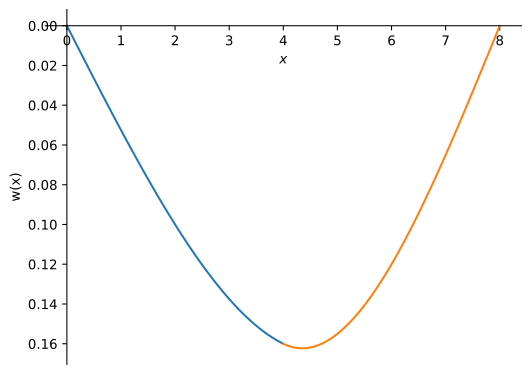
plot([w1_oplossing, w2_oplossing], [(0, 4), (4, 8)], 'w(x)')
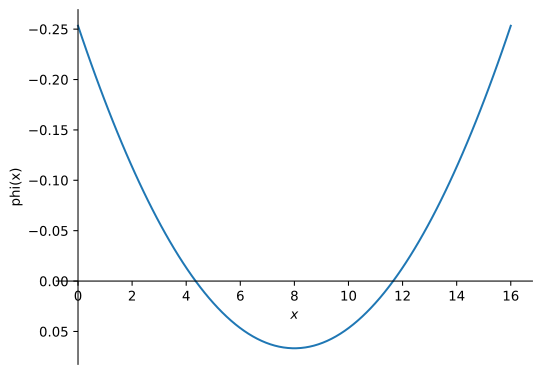
plot([phi2_oplossing], [(0, 16)], 'phi(x)')
display(phi2_oplossing)
\[\displaystyle - \frac{x^{2}}{200} + \frac{2 x}{25} - \frac{19}{75}\]
eq9 = sym.Eq(phi2_oplossing, 0)
max_buiging_x = sym.solve(eq9, x)[0] # m
display(max_buiging_x)
display(max_buiging_x.evalf())
max_buiging = w2_oplossing.subs(x, max_buiging_x)*1000 # mm
display((max_buiging).simplify())
display((max_buiging).evalf())
\[\displaystyle 8 - \frac{2 \sqrt{30}}{3}\]
\[\displaystyle 4.34851628329889\]
\[\displaystyle \frac{800 \sqrt{30}}{27}\]
\[\displaystyle 162.288165186716\]
plot([M1_oplossing, M2_oplossing], [(0, 4), (4, 8)], 'M(x)')
plot([V1_oplossing, V2_oplossing], [(0, 4), (4, 8)], 'M(x)')
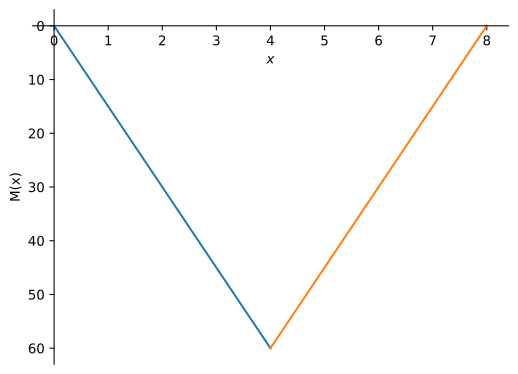
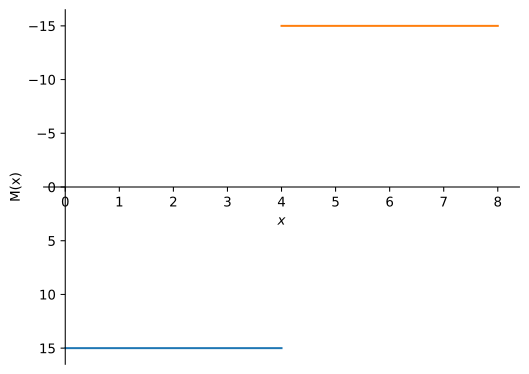
max_moment_x = 4 # m
max_moment = M1_oplossing.subs(x, max_moment_x) # kNm
display(max_moment)
\[\displaystyle 60\]