
Lesson November 10th#

Today we’ll discuss the results of the first exam assignment on Statically indeterminate structures.

Results first exam assignment on Statically indeterminate structures#

Discussed based on frequently made mistakes as shown in Exam Friday November 7th

Demonstration transforming stresses#

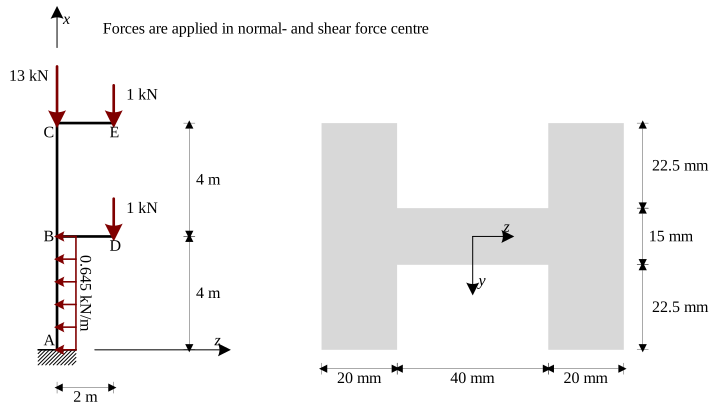
Given the following structure and cross section.
../../_images/structure4.svg

We’ll find the maximum stresses in point \(\rm{E}\) in cross-section \(\rm{A}\) and its direction.

Internal forces#

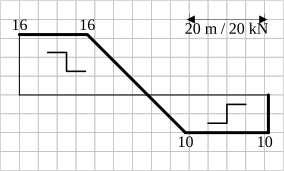
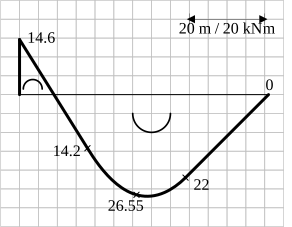
First, let’s find the internal forces:
../../_images/Mline.svg
../../_images/Vline.svg

At cross-section \(\rm{A}\) this gives a moment of \(-14.6 \rm{ kNm}\) and shear force of \(+16 \ \rm{ kN}\).

Cross-sectional properties#

For this thin-walled cross-section, the second moment of area of the cross-section can be calculated with:

\[ I_{\rm{zz}} = 2 \cdot \cfrac{1}{12} \cdot 4 \cdot 300 ^3 + 2 \cdot \left(\cfrac{1}{12} \cdot 100 \cdot 12^3 + 12 \cdot 100 \cdot 150^2 \right) = 72.0288 \cdot 10^6 \ \rm{ mm}^4\]

Normal and shear stresses#

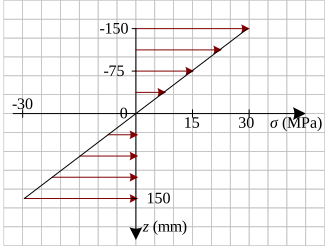
The normal stresses can be calculated as:

\[\sigma_{\rm{E}} = \cfrac{-14600 \cdot -0.075}{72.0288 \cdot 10^{-6}} \approx +15 \cdot 10^6 \ \rm{ Pa}\]
\[\sigma_{\rm{max}} = \cfrac{-14600 \cdot -0.150}{72.0288 \cdot 10^{-6}} \approx +30 \cdot 10^6 \ \rm{ Pa}\]

Leading to the following diagram:

../../_images/normall_stress.svg

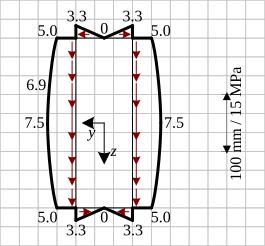
The shear forces can be calculated as:

\[\sigma_{\rm{xm,max,flange}} = - \cfrac{16000 \cdot 12 \cdot 100 \cdot -150}{2 \cdot 12 \cdot 72.0288 \cdot 10^{-6}} \approx 1.7 \cdot 10^6 \ \rm{ Pa}\]
\[\sigma_{\rm{xm,min,web}} = - \cfrac{16000 \cdot 12 \cdot 100 \cdot -150}{2 \cdot 4 \cdot 72.0288 \cdot 10^{-6}} \approx 5.0 \cdot 10^6 \ \rm{ Pa}\]
\[\sigma_{\rm{xm,E}} = - \cfrac{16000 \cdot \left(12 \cdot 100 \cdot -150 + 2\cdot 4\cdot 75 \cdot -112.5 \right)}{2 \cdot 4 \cdot 72.0288 \cdot 10^{-6}} \approx 6.9 \cdot 10^6 \ \rm{ Pa}\]
\[\sigma_{\rm{xm,max,web}} = - \cfrac{16000 \cdot \left(12 \cdot 100 \cdot -150 + 2\cdot 4\cdot 150 \cdot -75 \right)}{2 \cdot 4 \cdot 72.0288 \cdot 10^{-6}} \approx 7.5 \cdot 10^6 \ \rm{ Pa}\]

Leading to the following diagram:

../../_images/shear_stresses.svg

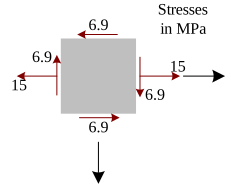
The stress state for a rectangular element at point \(\rm{E}\) is therefore:
../../_images/element.svg

Find maximum stress#

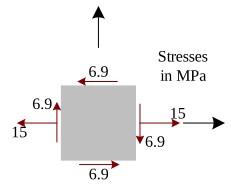
As the stress can be represented as a tensor. Therefore, a \(x,y\)-coordinate system is introduced:
../../_images/element2.svg

Leading to the tensor \(\sigma\):

\[\begin{split}\sigma = \left[ \begin{array}{} {15}&{-6.9}\\ {-6.9}&{0} \end{array} \right]{\ \rm{ MPa}}\end{split}\]

The maximum stress can be found by applying the transformation rules:

\[\sigma_1 = \frac{1}{2} \left(15 + 0\right) + \sqrt{\left(\frac{1}{2}\left(15-0\right)\right)^2 + \left(-6.9\right)^2} \approx 17 \ \rm{ MPa}\]

With a corresponding angle \(\alpha\):

\[ \alpha = \frac{1}{2} \arctan\left(\cfrac{-6.9}{\frac{1}{2}\left(15-0\right)}\right) \approx 21^{\rm{o}} \]