
Lesson November 25th

Lesson November 25th#

Today’s we’ll demonstrate how to evaluate failure criteria.

Demonstration failure criteria#

Given is the following structure and cross-section:
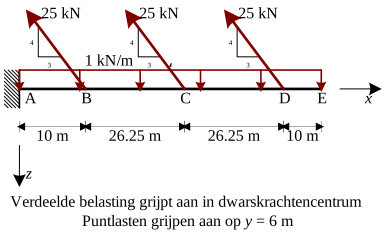
../../_images/constructie2.svg

Fig. 197 Structure and cross-section, with point \(\rm{C}\) in the cross-section of \(\rm{A}\).#

Evaluate where the shear force center is located and find the required yield stress of the material in order to prevent failure in point \(\rm{C}\) according to Tresca. Draw the required Tresca failure envelope too.

We can start with evaluating the internal forces in the structure:
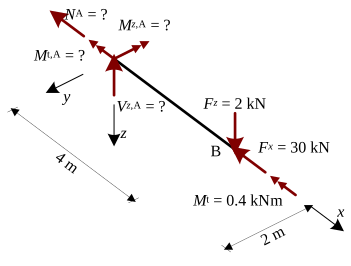
../../_images/VLS_3D.svg

Fig. 198 Free body diagram in 3D showing internal forces at \(\rm{A}\)#

This figure can also be drawn in 2D:
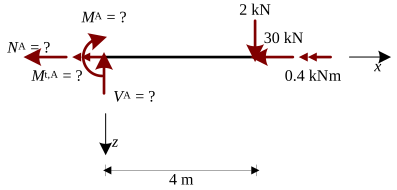
../../_images/VLS_2D.svg

Fig. 199 Free body diagram in 2D showing internal forces at \(\rm{A}\)#

\[\begin{split} \begin{align*} \sum T_{\rm{y}} &= 0 \\ -M_{z\rm{,A}} - 2 \cdot 4 &= 0 \\ M_{z\rm{,A}} &= -8 \ \rm{kNm} \left( â—  \right) \end{align*} \end{split}\]
\[\begin{split} \begin{align*} \sum F_{\rm{z}} &= 0 \\ -V_{z\rm{,A}} + 2 &= 0 \\ V_{z\rm{,A}} &= 2 \ \rm{kN} \left( ⎺|⎽ \right) \end{align*} \end{split}\]
\[\begin{split} \begin{align*} \sum F_{\rm{x}} &= 0 \\ -N_{\rm{A}} -30 &= 0 \\ N_{\rm{A}} &= -30 \ \rm{kN} \left( - \right) \end{align*} \end{split}\]
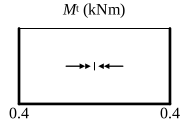
\[\begin{split} \begin{align*} \sum T_{\rm{x}} &= 0 \\ -M_{\rm{t,A}} -0.4 &= 0 \\ M_{\rm{t,A}} &= -0.4 \ \rm{kNm} \left( \twoheadrightarrow \mid \twoheadleftarrow \right) \end{align*} \end{split}\]

The torsional moment distribution can also be shown like the other internal forces distributions:
../../_images/Mt.svg

Fig. 200 Torsional moment distribution along the structure.#

This cross-section is symetrical in the \(y\)-axis, therefore the centroid is located at \(z=0\). Furthermore, that means that if the structure is loaded in the \(y\)-direction only, the normal and shear stress will form a symmetrical pattern too. However, that’s not true for loading in the \(z\)-direction. Therefore, the stresses in the whole cross-section are calculated.

\[\begin{split} \begin{align*} A &= 200 \cdot 15 \cdot 3 + 50 \cdot 15 \cdot 2 = 10500 \, \rm{mm^2} \\ I_{zz} &= \frac{1}{12} \cdot 15 \cdot 200^3 \\ & \, \, \, + 2 \cdot \left( \frac{1}{12} \cdot 200 \cdot 15^3 + 15 \cdot 200 \cdot 100^2 \right) \\ & \, \, \, + 2 \cdot \left( \frac{1}{12} \cdot 15 \cdot 50^3 + 50 \cdot 15 \cdot 75^2 \right) \\ &= 79 \cdot 10^6 \, \rm{mm^4} \end{align*} \end{split}\]

Now the normal stress distribution can be found:
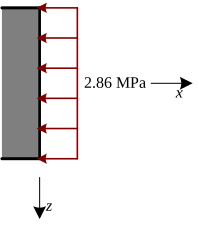
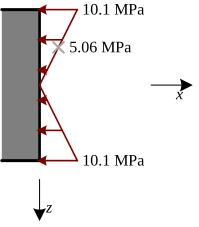
\[\begin{split} \begin{align*} \sigma_{\rm{N}} &=\frac{-30 \cdot 10^3}{10500} = -2.86 \, \rm{MPa} \\ \sigma_{\rm{M,flange}} &= \frac{-8 \cdot 10^6 \cdot 100}{79 \cdot 10^6} = 10.1 \, \rm{MPa} \\ \sigma_{\rm{M,C}} &= \frac{-8 \cdot 10^6 \cdot 50}{79 \cdot 10^6} = 5.06 \, \rm{MPa} \\ \end{align*} \end{split}\]
../../_images/sigma_N.svg

Fig. 201 Normal stresses due to axial force#
../../_images/sigma_M.svg

Fig. 202 Normal stresses due to bending moment#

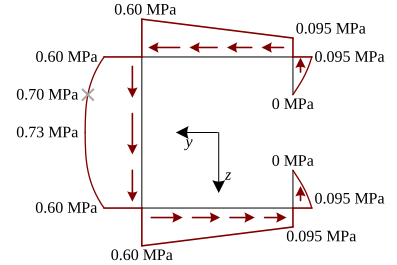
Furthermore, the shear stress distribution due to the shear force can be found:

\[\begin{split} \begin{align*} \tau_{V\rm{,flange,right}} &= \frac{2 \cdot 10^3 \cdot 50 \cdot 15 \cdot 75}{15 \cdot 79 \cdot 10^6} = 0.095 \, \rm{MPa} \\ \tau_{V\rm{,flange,left}} &= \frac{2 \cdot 10^3 \cdot \left( 50 \cdot 15 \cdot 75 + 200 \cdot 15 \cdot 100 \right) }{15 \cdot 79 \cdot 10^6} = 0.60 \, \rm{MPa} \\ \tau_{V\rm{,C}} &= \frac{2 \cdot 10^3 \cdot \left( 50 \cdot 15 \cdot 75 + 200 \cdot 15 \cdot 100 + 50 \cdot 15 \cdot 75 \right)}{15 \cdot 79 \cdot 10^6} = 0.70 \, \rm{MPa}\\ \tau_{V\rm{,max}} &= \frac{2 \cdot 10^3 \cdot \left( 50 \cdot 15 \cdot 75 + 200 \cdot 15 \cdot 100 + 100 \cdot 15 \cdot 50 \right)}{15 \cdot 79 \cdot 10^6} = 0.73 \, \rm{MPa}\\ \end{align*} \end{split}\]

Leading to

../../_images/shear1.svg

Fig. 203 Shear stresses due to shear force#

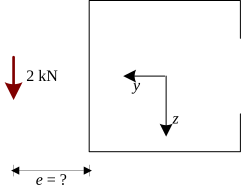
As can be seen from the shear stresses, although they are in horizontal and vertical equilibrium, they create a counter-clockwise rotation around the centroid, effectively leading to a torsional moment. As this torsional moment isn’t there in the structure, it can be though of as the shear force itself acting eccentrically:
../../_images/V.svg

Fig. 204 Shear force acting eccentrically#

The location of where the shear force acts to have the same torsional moment effect as the shear stresses, is called the shear force centre. It can be calculated by comparing Fig. 203 with Fig. 204, which both should have the same torsional moment around any point.

\[\begin{split} \begin{align*} \sum T_{\bar x\rm{,web,stresses}} &= \sum T_{\bar x\rm{,web,shear} \, \rm{force}} \\ \cfrac{2000 \int_{0}^{50} \left( 15 \ z \cdot \left( 50 + z/2\right) \right) dz }{15 \cdot 79 \cdot 10^6} \ 15 \cdot 200 \\ + 0.095 \cdot 15 \cdot 200 \cdot 100 \\ + 0.095 \cdot 15 \cdot 200 \cdot 100 \\ + \cfrac{2000 \int_{0}^{50} \left( 15 \ z \cdot \left( -50 - z/2\right) \right) dz }{15 \cdot 79 \cdot 10^6} \ 15 \cdot 200 &= 2000 \cdot e \\ e &\approx 111 \, \rm{mm} \end{align*} \end{split}\]

Note that an integral is used to calculate the moment of the varying shear stress in the web as it changes parabolically. If the parabola has a known minimum and maximum value, the integral can be simplified to \(\frac{1}{3}bh\) and \(\frac{2}{3}bh\) respectively.

So the shear force center is located at approximately \(111 \, \rm{mm}\) left of the web.

Now we can continue finding the stresses at point \(\rm{C}\), combining the normal and shear stresses, with the stress due to the torsional moment. Note that there’s no additional torsion moment other than the \(-0.4 \, \rm{kNm}\), as the external force is applied at the shear force center.

We have an open-thin walled cross-section, therefore, the torsional cross-sectional property, the torsion constant \(I_{\rm{t}}\), can be calculated with:

\[\begin{split} \begin{align*} I_{\rm{t}} &= \frac{1}{3} \cdot \sum \left( t_i^3 \cdot h_i \right) \\ &= \frac{1}{3} \cdot \left( 3 \cdot 15^3 \cdot 200 + 2 \cdot 15^3 \cdot 50 \right) \\ &= 787500 \, \rm{mm^4} \end{align*} \end{split}\]

The shear stress due to torsion can now be calculated as:
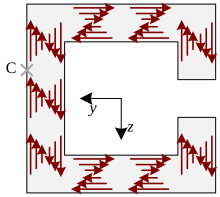
\[\begin{split} \begin{align*} \tau_{\rm{t,C}} &= \left| \cfrac{M_t \cdot e_{\rm{m}}}{\frac{1}{2} I_{\rm{t}}} \right| \\ \tau_{\rm{t,C}} &= \left| \cfrac{-0.4 \cdot 10^6 \cdot 7.5}{0.5 \cdot 787500} \right| \\ \tau_{\rm{t,C}} &\approx 7.62 \, \rm{MPa} \end{align*} \end{split}\]
../../_images/shear_stress_flow.svg

Fig. 205 Shear stresses due to torsional moment, with thickness of the walls exaggerated for clarity.#

This stress is working clockwise in the cross-section, so upwards in \(\rm{C}\) (where the shear stress due to bending was acting downwards). The total stress state at point \(\rm{C}\) can now be summarised in the following stress tensor:
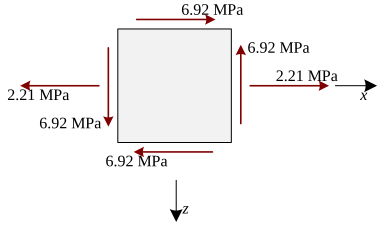
\[\begin{split} \sigma = \left[ \begin{array}{} {-2.86 + 5.06}&{0.70 - 7.62}\\ {0.70 - 7.62}&{0} \end{array} \right] = \left[ \begin{array}{} {2.21}&{-6.92}\\ {-6.92}&{0} \end{array} \right] {\ \rm{ MPa}} \end{split}\]
../../_images/stress-state.svg

Fig. 206 Stress state at point \(\rm{C}\)#

The principal stresses can be calculated as:

\[\begin{split} \begin{align*} \sigma_{1,2} &= \frac{2.21 + 0}{2} \pm \sqrt{ \left( \frac{2.21 - 0}{2} \right)^2 + \left(6.92\right)^2 } \\ \sigma_{1,2} &\approx 8.05 \, \rm{MPa} \, , \, -5.84 \, \rm{MPa} \end{align*} \end{split}\]

According to the Tresca failure criterion in 2D, the material will fail when:

\[\begin{split} \begin{align*} \left| \sigma_1 - \sigma_2 \right| &\geq \sigma_{\rm{y}} \\ \left| 8.05 - \left( -5.84 \right) \right| &\geq \sigma_{\rm{y}} \\ 14 \geq \sigma_{\rm{y}} \end{align*} \end{split}\]

So the yield stress of the material should be at least \(14 \, \rm{MPa}\) to prevent failure in point \(\rm{C}\).
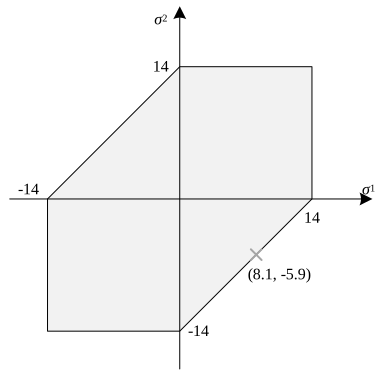
../../_images/envelope.svg

Fig. 207 Tresca failure envelope showing the stress state at point \(\rm{C}\)#