

Lesson November 24th#
During today’s lesson you’ll work on a complex exercise on the topic of the stress-strain relations. Please ask your questions regarding the homework as well!
Exercise stress-strain relations#
Given is the following stress element:
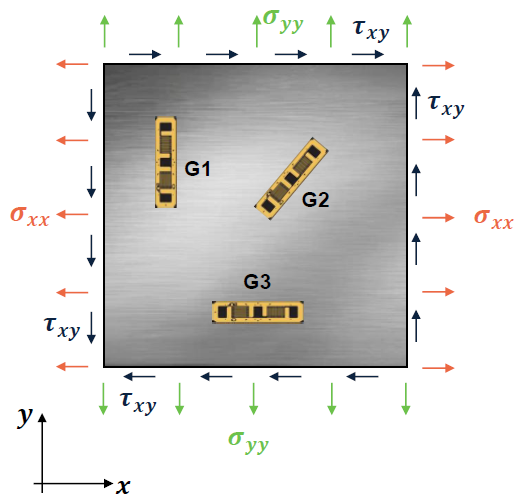
Fig. 195 Aluminium plate with strain gauges: \(E = 70 \ \rm{ GPa}\), \(\nu = 0.33 \ \rm{(-)}\), \(\varepsilon_{\rm{G1}} = -1.0 \cdot 10^{-3}\), \(\varepsilon_{\rm{G2}} = 2 \cdot 10^{-3}\), \(\varepsilon_{\rm{G3}} = +2 \cdot 10^{-3}\).#
Find the strain tensor
Find the principal strains
Find the stress tensor
Find the principal stresses
Solution assignment 1
Solution assignment 2
\(\varepsilon_{1} = 2.62 \cdot 10^{-3}\)
\(\varepsilon_{2} = -1.62 \cdot 10^{-3}\)
Solution assignment 3
Solution assignment 4
\(\varepsilon_{1} = 163.9 \, \rm{MPa}\)
\(\varepsilon_{2} = -59.4 \, \rm{MPa}\)
Exercise stress-strain relations 2#
Given is the following stress element:
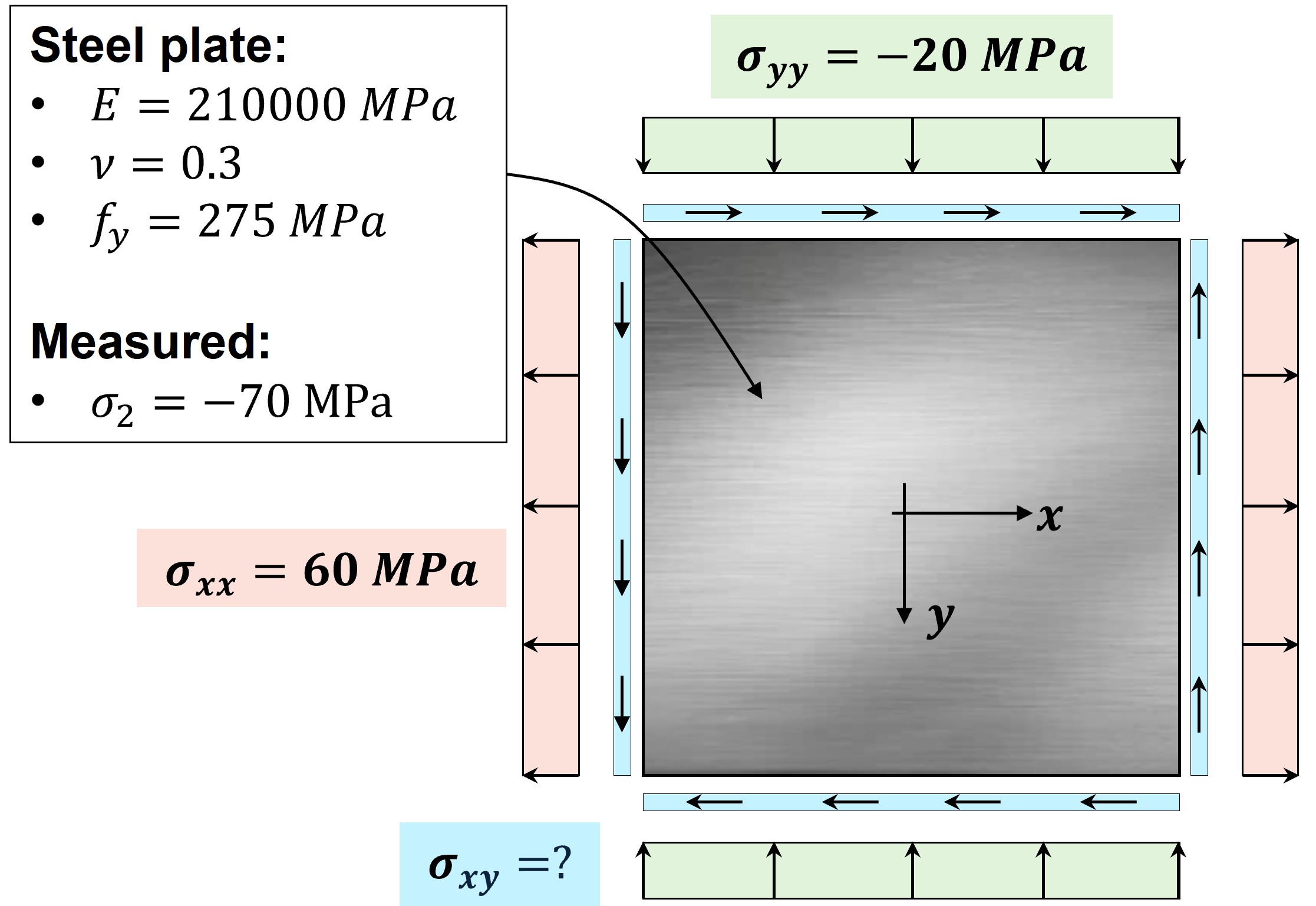
Fig. 196 This plate of steel (\( E =210000 \, \rm{MPa}, \nu = 0.3, f_y =275 \, \rm{MPa}\)) is tested in homogeneous plane stress conditions. It is measured that \( \sigma_{xx} = 60 \, \rm{MPa}\) and \(\sigma_{yy} = -20 \, \rm{ MPa}\). (Note: in the drawing, the normal stress in y-direction is already represented in compression) We also know that the value of the minimum principal stress is \(\sigma_2=−70 \, \rm{ MPa}\)#
Compute the value of the shear stress \(\sigma_{xy}\) (assume a positive value for \(\sigma_{xy}\)).
Compute \(\varepsilon_{xx}\), \(\varepsilon_{yy}\), \(\varepsilon_{xy}\) and \(\varepsilon_{zz}\).
Solution assignment 1
Solution assignment 2
\(\varepsilon_{xx} = 0.000314\)
\(\varepsilon_{yy} = -0.000181\)
\(\varepsilon_{xy} = 0.000499\)
\(\varepsilon_{zz} = -0.000057\)