

Lesson October 20th#
During today’s lesson it’s demonstrated how you to handle Temperature influences, stiffness discontinuities and support settlement for statically indeterminate structures.
Stiffness discontinuities#
Let’s investigate the stiffness discontinuities first. Consider the following structure:
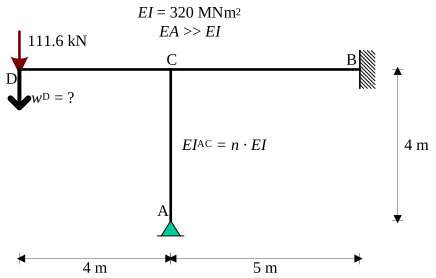
In which we will investigate the influence of a varying stiffness of \(\rm{AC}\) on the displacement of \(\rm{D}\). There are two approaches to do this: (1) do the calculation including a multiplication factor \(n\) for the stiffness of \(\rm{AC}\), or (2) investigating the extremes by simplifying the structure by replacing \(\rm{AC}\) with an infinite stiff member and a zero stiff member.
Multiplication factor#
Let’s start with this first approach.
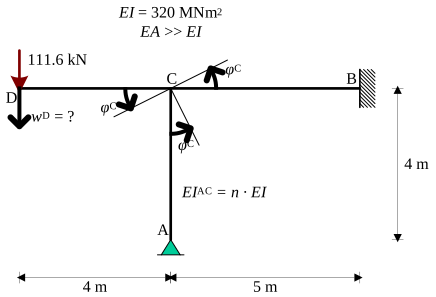
We’ll solve the structure by using the displacement method with the rotation of \(\varphi_{\rm{C}}\) as degree of freedom:
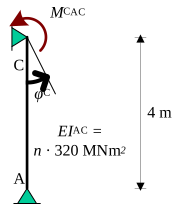
For \(\rm{AC}\) this gives:
For \(\rm{BC}\) this gives:
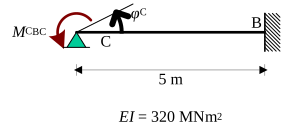
Now \(\varphi_{\rm{C}}\) can be determined:
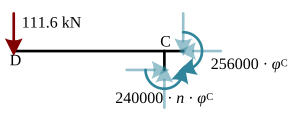
Now, the displacement of \(\rm{D}\) can be determined by extending the rotation of \(\varphi_{\rm{C}}\) over member \(\rm{CD}\) and add vertical displacement due to the load:
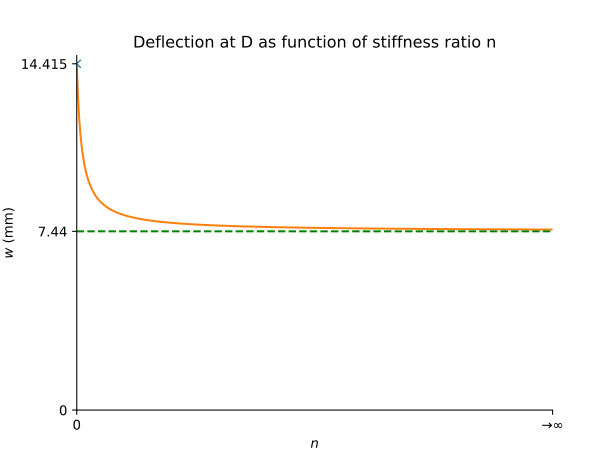
This result can be plotted for different values of \(n\):
Extreme cases#
Instead of evaluating the displacement for different values of \(n\), we can also investigate the extreme cases: \(n \to \infty\) and \(n = 0\).
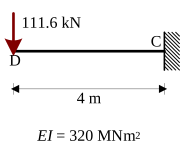
For \(n \to \infty\), no rotation is allowed in \(\rm{C}\), which reduces the structure to a statically determinate structure:
Which gives a displacement using forget-me-nots of:
This could also be reasoned by taking the limit of the previous expression for \(w_{\rm{D}}\) when \(n \to \infty\):
For \(n = 0\), member \(\rm{AC}\) doesn’t give rotational stiffness to node \(\rm{C}\), which reduces the structure to:
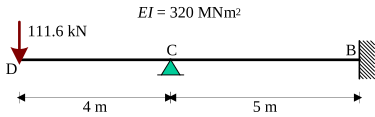
Which is a statically indeterminate structure which can be solved with any method of your choice. It will lead to:
This could also be reasoned by taking the limit of the previous expression for \(w_{\rm{D}}\) when \(n = 0\):
Support settlement#
Next, let’s investigate the influence of support settlement. Consider the following structure:
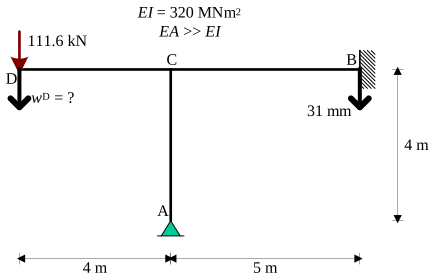
For statically indeterminate structures, the support settlements will cause internal forces and moments in the structure, as opposed to statically determinate structures where support settlements only causes rigid body displacements
The displacements can be taken into account when applying a force or displacement method. Here, we’ll use the force method.
The degree of statical determinacy can be found by evaluating the external statical determinacy: the structure is not a closed structure, so the internal statical determinacy is equal to the external statical determinacy.
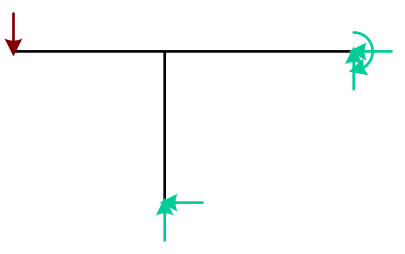
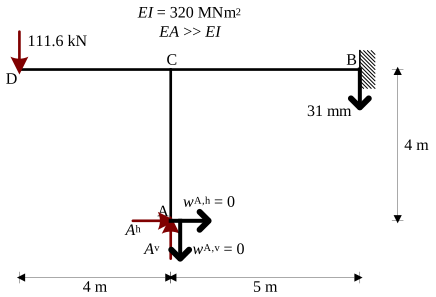
There are 5 support reaction and one rigid body with 3 equilibrium equations, so the structure is statically indeterminate to the second degree. So, the strucutre is made statical determinate by releasing both the horizontal and vertical support at \(\rm{A}\):
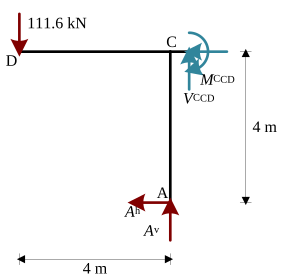
The shear force and bending moment just right of \(\rm{C}\) can be determined using equilibrium:
The displacement and rotation of \(\rm{C}\) can be determined with forget-me-nots and the support settlement of \(\rm{B}\):
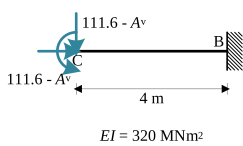
Now, the displacement of \(\rm{A}\) can be determined with the vertical displacement of \(\rm{C}\), extending the rotation of \(\varphi_{\rm{C}}\) over member \(\rm{AC}\) and the additional displacement due to \(A_{\rm{h}}\):
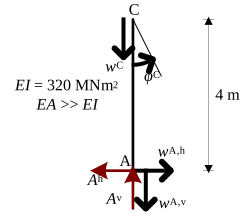
Solving for the displacement conditions gives:
With solving the displacement conditions the statically indeterminate structures is essentially solved. The other reaction forces and displacement can be solved for too.
Temperature influences#
Finally, let’s investigate the influence of temperature changes. Consider the following structure:
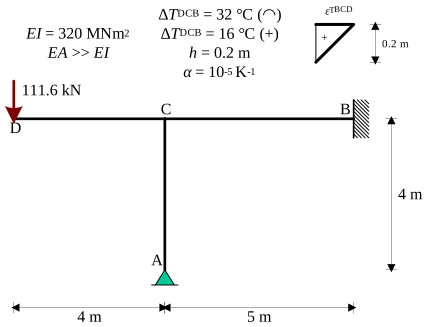
In this structure, the beam \(\rm{DCB}\) is warmed up. The top side expands most, while the bottom fibre doesn’t expand. The expansion can be defined with \(\epsilon^{\rm{T}}\) and \(\kappa^{\rm{T}}\). These can be calculated with:
These strains and curvatures wouldn’t cause internal forces in a statically determinate structure, but in this statically indeterminate structure they do. When solving with the force method, it could be thought of as the statically indeterminate forces lead to internal forces because of the additional displacement caused by the temperature changes:
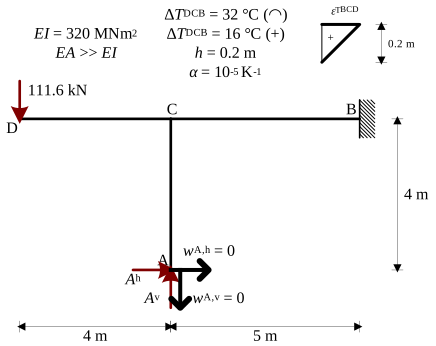
To calculate the displacements based on the known strains, the displacement can simply be calculated with \(\Delta L = \epsilon \cdot L\). For the displacement due to curvature, the curvature can be found by including a kinematic equivalent force, which would lead to the same curvature. This force can be found by \(M^{\rm{T}} = E I \cdot \kappa^{\rm{T}}\), which gives:
When this moment is added to the structure at \(\rm{D}\) in the counterclockwise direction, the curvature caused by this moment is equal to the curvature caused by the temperature change. The moment should only be considered for calculating curvatures, rotations and displacements, not for calculating internal forces as it’s just a trick to be able to apply forget-me-nots.
This leads to the following structure, with the kinematically equivalent force indicated with a dashed line:
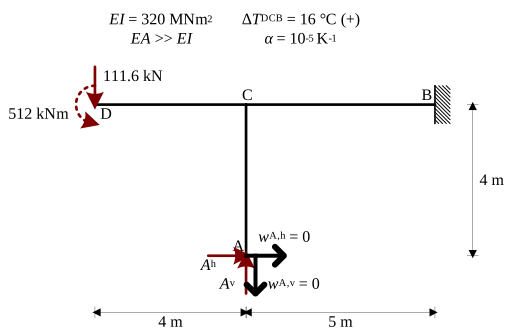
Now the displacements at \(\rm{C}\) can be calculated in the same way as before, but by adding the influence of the temperature changes of the curvature:
The displacements at \(\rm{A}\) can be calculated in the same way as before, but including now the temperature expansion of \({\rm{BC}}\):
Again, solving for the displacement conditions gives:
As before, the force distribution and displacement can be solved for. However, the kinematically equivalent force should not be included in the internal force calculations.