

Exam Tuesday December 9th#
Today you’ll make the second exam assignment covering Statically indeterminate structures including its prerequisites and/or the first exam assignment covering Continuum mechanics including its prerequisites. For more information about the exam see the assessment information in course information
Exam assignment 2 Statically indeterminate structures#
Your own submission and its grading will be available on  exam assignment Statically indeterminate structures 2 after the exam.
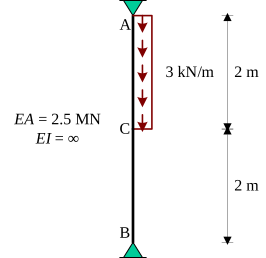
Given is the following structure:
Exercise
Show that this structure is statically indeterminate to the second degree.
Solution
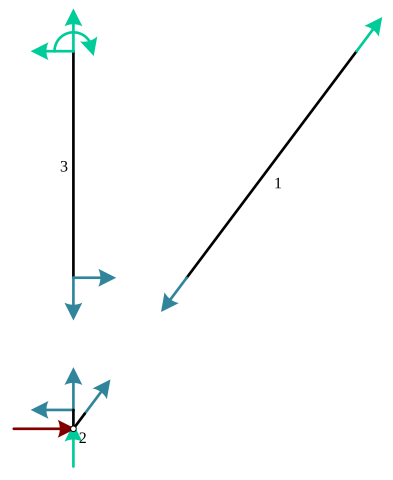
For this structure, the external static indeterminacy is equal to the internal static indeterminacy.
There are 8 unknowns and 6 equilibrium equations, making the structure statically indeterminate to the second degree.
Exercise
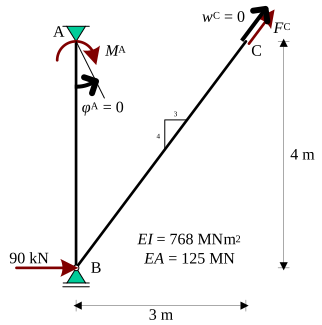
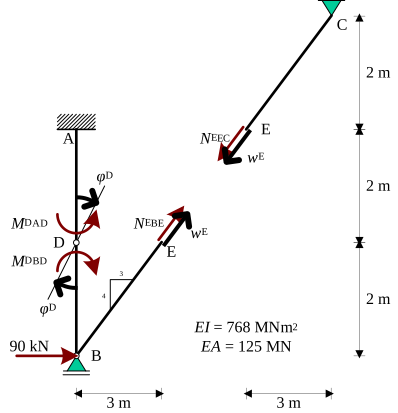
Provide two alternative valid variants to make this structure statically determinate for the purpose of the force method or displacement method with statically indeterminate displacements. Provide two different variants: your adjustments must each modify a different part of the structure. For each of the variants, provide the necessary equation(s) to determine the statically indeterminate force(s) or statically indeterminate displacement(s).
Solution
A few potential variants are:
Frequently made mistakes
Creating a mechanism
Many students created a mechanism by replacing the fixed support in A with a horizontal roller support.
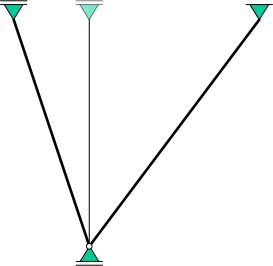
Fig. 225 Mechanism created when replacing fixed support in A with horizontal roller support#
Exercise
Determine the support bending moment in \(\rm{A}\) using the force- or a displacement method.
Solution
As an example, the displacement method with as degree of freedom the horizontal displacement in \(\rm{B}\), but other methods could be used too:
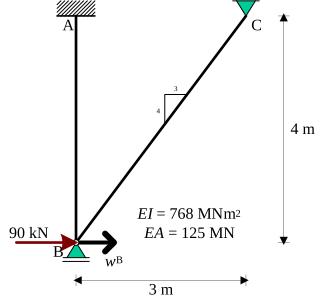
Fig. 226 Structure with degree of freedom the horizontal displacement in \(\rm{B}\)#
The free body diagram of the split structure is:
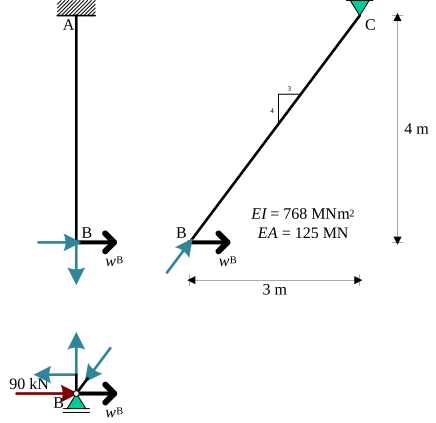
Fig. 227 Split structure#
For both parts we can now find internal forces at \(\rm{B}\) as a function of \(w_{\rm{B}}\). We are especially interested in the horizontal forces, since there will also be an unknown vertical support reaction in \(\rm{B}\) to be solved for in the vertical direction.
First, the effect of the horizontal displacement on segment \(\rm{AB}\) is considered. For this, the following forget-me-not applies, leading to internal forces in the shown direction:
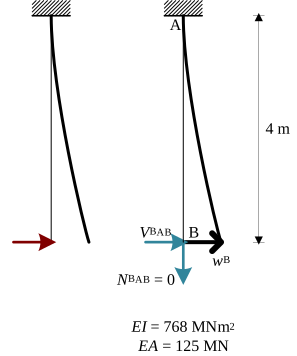
Fig. 228 On the left the forget-me-not to calculate the internal forces due to on segment corresponding to forget-me-not (2) from the book Mechanics, Statically indeterminate structures and failure analysis Hartsuijker and Welleman (2007). On the right the split segment with the resulting internal forces.#
For \(\rm{BC}\):
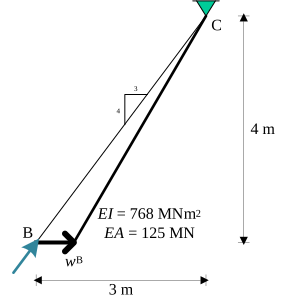
Fig. 229 Part \(\rm{BC}\) loaded with an axial force, shortened and rotated.#
We can use Williot to find the shortening:
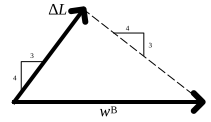
Fig. 230 Williot diagram of the displacement in \(\rm{B}\) and the shortening of \(\rm{BC}\)#
And thus:
Now that we have the horizontal internal forces, we can set up the equilibrium equations for node \(\rm{B}\):
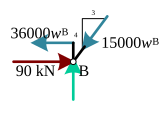
Fig. 231 Free body diagram of node \(\rm{B}\)#
Now, the horizontal reaction in \(\rm{A}\) can be determined using another forget-me-not:

Fig. 232 On the left the forget-me-not to calculate the internal forces due to on segment corresponding to forget-me-not (f) from the book Mechanics, Statically indeterminate structures and failure analysis Hartsuijker and Welleman (2007). On the right the split segment with the resulting internal forces and support reactions.#
Alternative solution
An alternative solution is to use the force method with as statically indeterminate forces the moment and vertical force in \(\rm{A}\). This is shown here.
Frequently made mistakes
Trying to solve displacement of mechanism
The mechanism created in the previous exercise cannot be used to determine displacements, since it is a mechanism. Some students still tried to determine displacements of this mechanism, which is not possible.
Fig. 233 Mechanism created when replacing fixed support in A with horizontal roller support#
Incomplete Williot diagram
When the structure is made statically determinate by removing the roller support at \(\rm{B}\) and splitting the two-force member \(\rm{BC}\), like so:
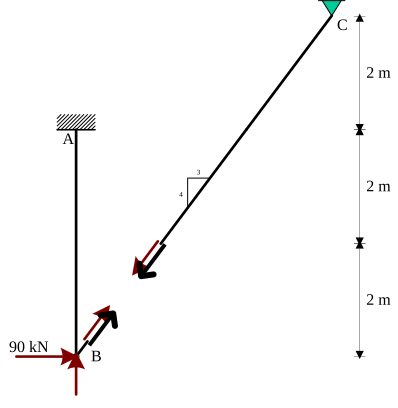
Fig. 234 Statically determinate structure after removing roller support in \(\rm{B}\) and splitting two-force member \(\rm{BC}\)#
The williot diagram in which \(\rm{B}\) only moves horizontally is incomplete: beam \(\rm{AB}\) will also shorten, leading to a vertical displacement in \(\rm{B}\) as well. This vertical displacement must also be taken into account in the williot diagram.
Exercise
Determine the support bending moment in \(\rm{A}\) in the extreme cases that \(EA_{\rm{BC}} \to 0\) and \(EA_{\rm{BC}} \to \infty\).
Solution
For \(EA_{\rm{BC}} \to 0\), segment \(\rm{BC}\) can be ignored for the purpose of load transfer. The structure then simplified to:
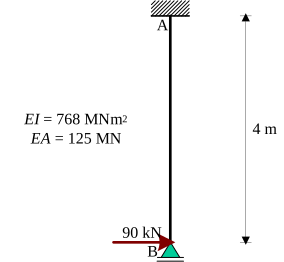
Fig. 235 Simplified structure for \(EA_{\rm{BC}} \to 0\)#
And the support moment in \(\rm{A}\) can be found using static equilibrium:
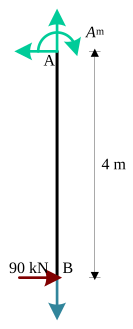
Fig. 236 Free body diagram of the simplified structure for \(EA_{\rm{BC}} \to 0\)#
For \(EA_{\rm{BC}} \to \infty\), support \(\rm{B}\) can be considered as a hinged support. The structure then simplified to:
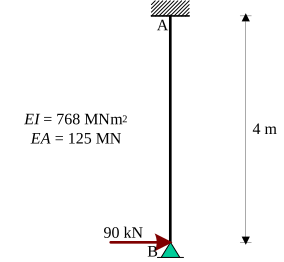
Fig. 237 Simplified structure for \(EA_{\rm{BC}} \to \infty\)#
This gives \(A_{\rm{m}} = 0 \, \rm{kNm}\) because the load is fully carried by the hinged support in \(\rm{B}\).
Frequently made mistakes
Not simplified
Although not wrong, some student redid their calculations as done in exercise 3 instead of explicitly simplifying the structure. For the cases \(EA_{\rm{BC}} \to 0\), only equilibrium can be used. For \(EA_{\rm{BC}} \to \infty\), a forget-me-not can be used.
Exam assignment 1 Continuum mechanics#
Your own submission and its grading will be available on exam assignment Continuum mechanics 1 after the exam.
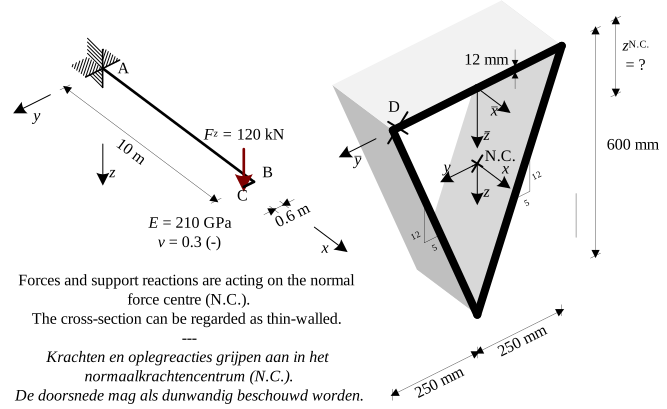
Given is the following structure and cross-section:
Exercise
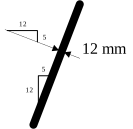
Show that \(A = 21600 \, \rm{mm^2}\), \(\bar z_{\rm{N.C.}} = \cfrac{650}{3} \approx 217 \, \rm{mm}\) and \(I_{zz} = 858.072 \cdot 10^6 \, \rm{mm^4}\).
Solution
Frequently made mistakes
Calculating \(I_{zz}\) incorrectly
Many studenten calculated \(I_{zz}\) of the diagonal parts of the cross-section with the incorrect formula: \(I_{zz} = \frac{1}{12} b h^3 \sin^2\left(\theta\right)\). This formula is incorrect. \(I_{zz}\) is actually part of a tensor (with \(I_{yy}\) and \(I_{yz}\)) and the correct transformation formulas could be used to find \(I_{zz}\) in the global coordinate system. However, looking at the diagonal element as a parallelogram would also work.
Exercise
Find the strain tensor at point \(\rm{D}\) in cross-section \(\rm{A}\) and indicate the coordinate system for this strain tensor.
Solution
The section force can be found using equilibrium:
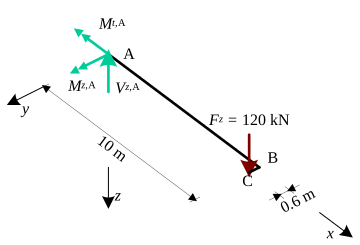
Fig. 238 Free body diagram with the section force at cross-section \(\rm{A}\)#
This gives the following normal and shear stresses (excluding the torsion for now):
For the torsional shear stresses, we can use the model for thin-walled, closed, non-circular cross-sections:
The shear stress due to bending and due to torsion act in the same direction, so they can be added. Leading to:
This gives the following strain tensor using Hooke’s law for plane stress:
Frequently made mistakes
Shear stresses due to bending forgotten
Some students only calculated the shear stresses due to torsion, forgetting the shear stresses due to bending.
Directions of shear stresses mixed up
Some students mixed up the directions of the shear stresses due to bending and torsion, leading to incorrect addition of the shear stresses or stresses in the wrong direction.
The internal forces act on a negative cut as follows:
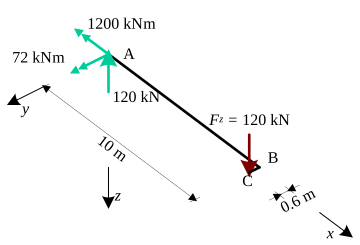
Fig. 239 Directions of internal forces#
Leading to shear stresses for both bending and torsion in the negative y-direction on a negative cut and in the positive y-direction on a positive cut.
Direction of tensor not clear
Many students wrote down a strain tensor without clearly indicating the coordinate system in which this tensor is acting (which should have been the \(xy\)-coordinate system) as the normal stresses in (thin-walled) point \(\rm{D}\) work in the \(x\)-direction and the shear stresses in the \(xy\)-plane. The strain tensor could have been described in the full 3D coordinate system too.
Exercise
Find the principle strains in point \(\rm{D}\) in cross-section \(\rm{A}\) and indicate their directions.
Solution
In an upward \(y\), rightward \(x\) coordinate system, the strain tensor is:
The direction of the principal strains can be found using:
The principal strains can be found using:
With \(\varepsilon_1\) at \(-5.2^\circ\) (clockwise) from the \(x\)-axis and \(\varepsilon_2\) at \(84.8^\circ\) (counterclockwise) from the \(x\)-axis.
Frequently made mistakes
Used transformation formula for \(x-y\) coordinate system for mirrored coordinate system
Many students applied the transformation formulas (which are valid for a rightward \(x\), upward \(y\) coordinate system) on another coordinate system (for example upward \(y\), rightward \(x\)). This can lead to incorrect results.
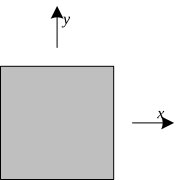
Fig. 240 THe transformation formulas are only valid for a rightward \(x\), upward \(y\) coordinate system.#
Not clear why \(\varepsilon_1\) is in the principle direction or at \(90^\circ\) from that one
Many students calculated the principal strains correctly and a direction. But from the direct formulas for principle strains it cannot be found which strain corresponds to which direction. This can only be found by substituting the directions back into the transformation formulas to see which strain corresponds to which direction.