
Lesson Wednesday Oktober 1st#
During today’s lesson it’s demonstrated how you to use the force method for statically indeterminate problems which involve bending.
Demonstration#
Given a structure as shown below:
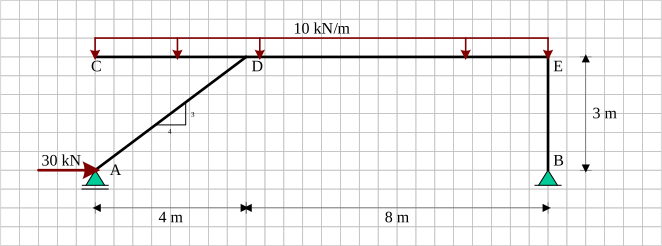
Fig. 93 Structure#
First, the degree of statically indeterminacy must be determined.

Fig. 94 Free body diagrams of hinged parts#
There are 7 unknown support reactions and 6 unknown internal forces. This gives an external degree of statical indeterminacy of 1. Since this structure is not a closed structure, the internal degree of statical indeterminacy is also equal to 1.
Now we can apply the force method. For this we need to transform the structure into a statically determinate structure. There are several ways to do this, of which some are incorrect when the transformed structure becomes a (partial) mechanism.
Some correct ways to transform the structure are:
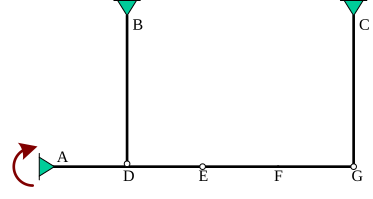
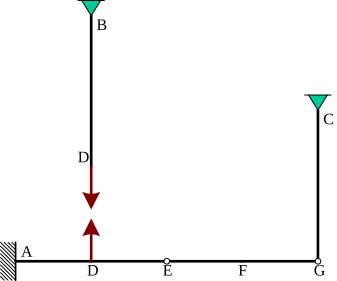
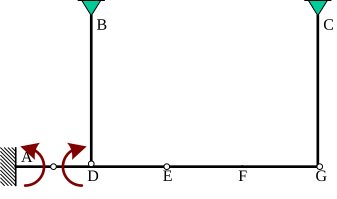
Some incorrect ways to transform the structure are:
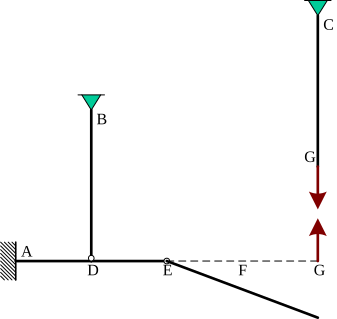
This creates a partial mechanism!
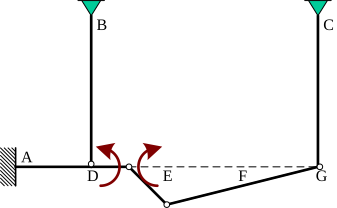
This creates a partial mechanism!
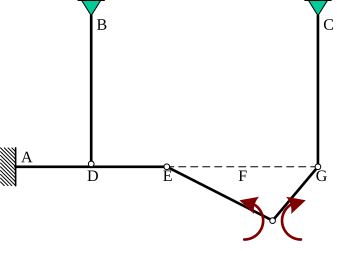
This creates a partial mechanism!
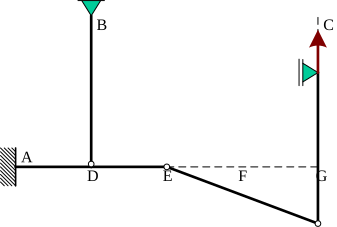
This creates a partial mechanism!
The following statically determinate structure is chosen, including a statically indeterminate force \(B_{\rm{v}}\) and a displacement constraint at point \(\rm{B}\), \(w_{\rm{B}} = 0\):
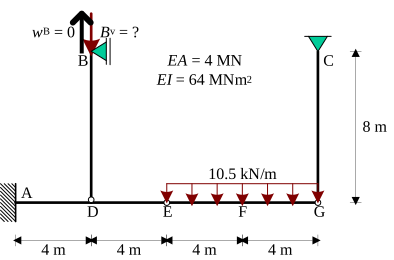
Now, the force distribution and displacement can be solved for.
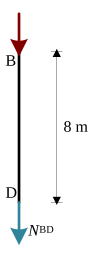
The normal force in member \(\rm{BD}\) is found with:
The normal force in member \(\rm{CG}\) is found with:
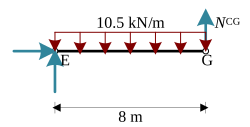
The shear force and bending moment just left of point \(\rm{D}\) is found with:
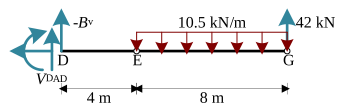
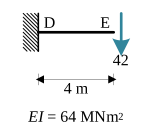
The displacement at point \(\rm{D}\) is found with a forget-me-not:
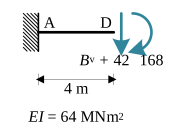
The displacement of \(\rm{B}\) can be found with the extension of a member due to axial forces:
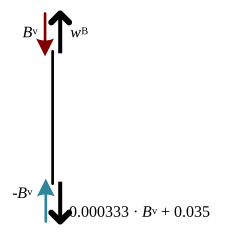
Now, the displacement constraint at point \(\rm{B}\) can be used to solve for the statically indeterminate force \(B_{\rm{v}}\):
Finally, with the found value for \(B_{\rm{v}}\), the internal forces and displacements can be calculated. For example, the displacement at \(\rm{E}\). The rotation at \(\rm{D}\) is found with a forget-me-not:
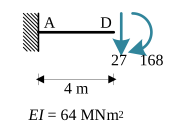
The shear force at \(\rm{E}\) is found with:
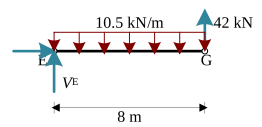
The displacement at \(\rm{E}\) is found with a forget-me-not: