

Lesson Monday September 22th#
During today’s lesson it’s demonstrated how you to use the force method for statically indeterminate problems which only involve extension
Demonstration#
Given a structure as shown below:
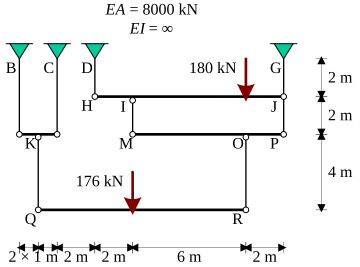
Fig. 34 Structure#
We can find the normal force distribution using the force method. Therefore, we need to know the degree of statically determinacy. The free-body-diagram of the full structure is as follows:
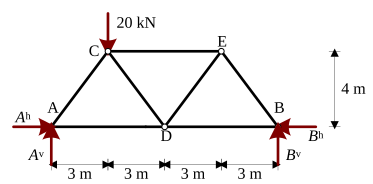
Fig. 35 Free-body-diagram full structure#
There are 4 unknown support reactions. With only 3 equilibrium equations for this self-contained structure, it can be concluded that this structure is a first-order statically determinant structure.
To apply the force method we need to replace a part of the structure by a statically indeterminate force, which turns the structure into a statically determinate structure. To solve the statically indeterminate structure we need to include a compatibility condition.
Define statically determinate structure with compatibility condition#
In this structure, we choose to replace the right support with a rolling hinged support. This leads to a horizontal statically indeterminate force \(B_\rm{v}\) with the compatibility conditions \(u_{h,\rm{B}} = 0\):
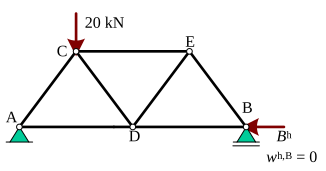
Fig. 36 Statically determinate structure with compatibility condition#
Solve displacements statically determinate structure in terms of statically indeterminate force#
The force distribution and displacements in this statically determinate structure is now solved for in terms of \(B_\rm{h}\).
Support reactions#
First, the support reactions are solved for
Fig. 37 Free-body-diagram full structure#
Leading to:
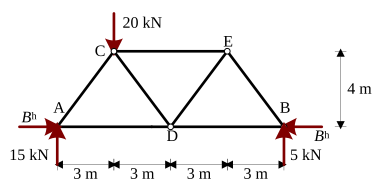
Fig. 38 Free-body-diagram full structure with resulting support reactions#
Section forces#
The section forces are solved for, starting with the forces in \(\rm{BE}\) and \(\rm{BD}\):
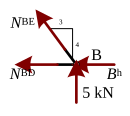
Fig. 39 Free-body-diagram joint \(\rm{B}\)#
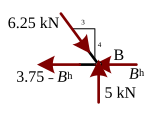
Fig. 40 Free-body-diagram joint \(\rm{B}\) with resulting sections forces#
Now, let’s continue with a section through beams \(\rm{AD}\), \(\rm{CD}\) and \(\rm{CE}\):
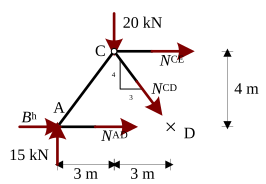
Fig. 41 Free-body-diagram part \(\rm{AC}\)#
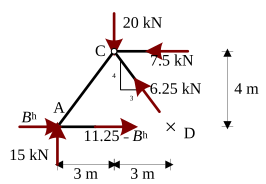
Fig. 42 Free-body-diagram part \(\rm{AC}\) with resulting section forces#
Thirdly, let’s continue with the joint \(\rm{D}\):
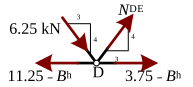
Fig. 43 Free-body-diagram joint \(\rm{D}\)#
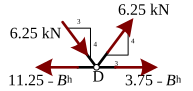
Fig. 44 Free-body-diagram joint \(\rm{D}\)#
And finally joint \(\rm{C}\):
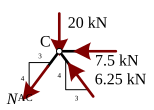
Fig. 45 Free-body-diagram joint \(\rm{D}\)#
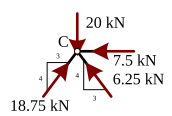
Fig. 46 Free-body-diagram joint \(\rm{D}\)#
Shortening/lengthening of elements#
Now, for each element the shortening / lengthening can be calculated:
Displacement structure due to \(20 \rm{ kN}\)#
For now we’ll ignore the shortening/lengethening due to \(B_\rm{h}\):
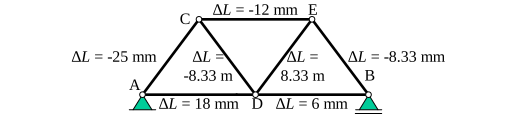
Fig. 47 Shortening/lengthening of elements#
This gives the following Williot-diagram with a fixed \(\rm{AC}\):
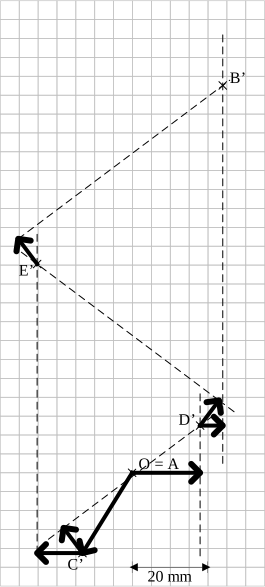
Fig. 48 Williot diagram with fixed \(\rm{AC}\)#
Leading to the following displacements if \(\rm{AC}\) doesn’t rotate:
joint |
Displacement due to \(20 \ \rm{ kN}\) with fixed \(\rm{AC}\) in horizontal direction → \(\left( \rm{mm}\right)\) |
Displacement due to \(20 \ \rm{ kN}\) with fixed \(\rm{AC}\) = in vertical direction ↓ \(\left( \rm{mm}\right)\) |
|---|---|---|
\(\rm{A}\) |
\(0\) |
\(0\) |
\(\rm{C}\) |
\(-15\) |
\(20\) |
\(\rm{D}\) |
\(18\) |
\(-15.1667\) |
\(\rm{E}\) |
\(-27\) |
\(-59.333\) |
\(\rm{B}\) |
\(24\) |
\(-108\) |
\(\rm{B}\) shouldn’t move vertically, so this structure has to be rotated back with \(\theta \approx \cfrac{{108}}{{12000}} = 9 \cdot {10^{ - 3}}{\rm{ rad}}\) ⟳, leading to:
joint |
Displacement due to \(\theta\) in horizontal direction → \(\left( \rm{mm}\right)\) |
Displacement due to \(\theta\) in vertical direction ↓ \(\left( \rm{mm}\right)\) |
|---|---|---|
\(\rm{A}\) |
\(0\) |
\(0\) |
\(\rm{C}\) |
\(36\) |
\(27\) |
\(\rm{D}\) |
\(0\) |
\(54\) |
\(\rm{E}\) |
\(36\) |
\(81\) |
\(\rm{B}\) |
\(0\) |
\(108\) |
Resulting in total displacements of:
joint |
Displacement due to in horizontal direction → \(\left( \rm{mm}\right)\) |
Displacement in vertical direction ↓ \(\left( \rm{mm}\right)\) |
|---|---|---|
\(\rm{A}\) |
\(0\) |
\(0\) |
\(\rm{C}\) |
\(21\) |
\(47\) |
\(\rm{D}\) |
\(18\) |
\(38.833\) |
\(\rm{E}\) |
\(9\) |
\(21.67\) |
\(\rm{B}\) |
\(24\) |
\(0\) |
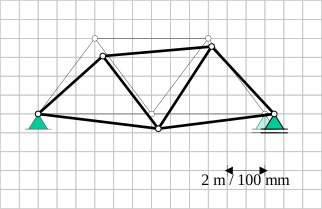
Fig. 49 Displaced structure#
Displacement structure due to \(B_\rm{h}\)#
For the displacement due to \(B_\rm{h}\) in \(\rm{kN}\), the following Williot-diagram with a fixed \(\rm{AD}\) can be drawn:
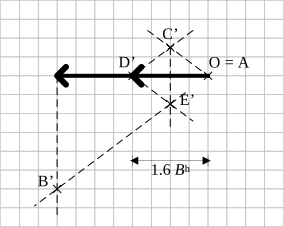
Fig. 50 Williot diagram with fixed \(\rm{AD}\)#
Leading to the following displacements if \(\rm{AD}\) doesn’t rotate:
joint |
Displacement due to \(B_\rm{h}\) in horizontal direction → |
Displacement due to \(B_\rm{h}\) in vertical direction ↓ |
|---|---|---|
\(\rm{A}\) |
\(0\) |
\(0\) |
\(\rm{C}\) |
\(-0.8{B_{\rm{h}}}\) |
\(-0.6{B_{\rm{h}}}\) |
\(\rm{D}\) |
\(-1.6{B_{\rm{h}}}\) |
\(0\) |
\(\rm{E}\) |
\(-0.8{B_{\rm{h}}}\) |
\(0.6{B_{\rm{h}}}\) |
\(\rm{B}\) |
\(-3.2{B_{\rm{h}}}\) |
\(2.4{B_{\rm{h}}}\) |
Again, \(\rm{B}\) Shouldn’t move vertically, so this structure has to be rotated back with \(\theta = \cfrac{2.4{B_{\rm{h}}}}{{12000}} = 0.0002{B_{\rm{h}}} \ {\rm{ rad}}\) ⟲, leading to:
joint |
Displacement due to \(\theta\) in horizontal direction → \(\left( \rm{mm}\right)\) |
Displacement due to \(\theta\) in vertical direction ↓ \(\left( \rm{mm}\right)\) |
|---|---|---|
\(\rm{A}\) |
\(0\) |
\(0\) |
\(\rm{C}\) |
\(-0.8 B_\rm{h}\) |
\(-0.6 B_\rm{h}\) |
\(\rm{D}\) |
\(0\) |
\(-1.2B_\rm{h}\) |
\(\rm{E}\) |
\(-0.8 B_\rm{h}\) |
\(-1.8B_\rm{h}\) |
\(\rm{B}\) |
\(0\) |
\(-2.4 B_\rm{h}\) |
Resulting in total displacements of:
joint |
Displacement due to in horizontal direction → \(\left( \rm{mm}\right)\) |
Displacement in vertical direction ↓ \(\left( \rm{mm}\right)\) |
|---|---|---|
\(\rm{A}\) |
\(0\) |
\(0\) |
\(\rm{C}\) |
\(-1.6B_\rm{h}\) |
\(-1.2B_\rm{h}\) |
\(\rm{D}\) |
\(-1.6{B_{\rm{h}}}\) |
\(-1.2B_\rm{h}\) |
\(\rm{E}\) |
\(-1.6B_\rm{h}\) |
\(-1.2B_\rm{h}\) |
\(\rm{B}\) |
\(-3.2B_\rm{h}\) |
\(0\) |
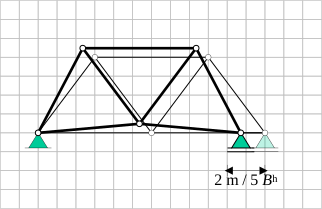
Fig. 51 Displaced structure#
Solve statically indeterminate structure with compatibility conditions#
Now, we can fill in the compatibility conditions:
Section forces statically indeterminate structure#
The section forces can be calculated by filling in the resulting \(B_\rm{h}\) in our previous expressions:
Element |
Normal force \(\rm{kN}\) |
|---|---|
\(\rm{AC}\) |
-18.75 |
\(\rm{CE}\) |
-7.5 |
\(\rm{BE}\) |
-6.25 |
\(\rm{CD}\) |
-6.25 |
\(\rm{DE}\) |
6.25 |
\(\rm{AD}\) |
3.75 |
\(\rm{DB}\) |
-3.75 |
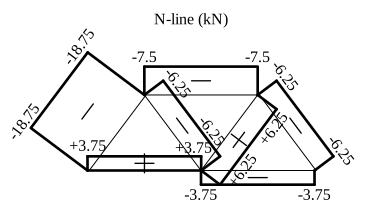
Fig. 52 Normal force distribution#
Displacements statically indeterminate structure#
Now, the displacements can be found as well by filling in the resulting \(B_\rm{h}\) in our previous expressions:
joint |
Displacement in horizontal direction → \(\left( \rm{mm}\right)\) |
Displacement in vertical direction ↓ \(\left( \rm{mm}\right)\) |
|---|---|---|
\(\rm{A}\) |
\(0\) |
\(0\) |
\(\rm{C}\) |
\(9\) |
\(38\) |
\(\rm{D}\) |
\(6\) |
\(29.833\) |
\(\rm{E}\) |
\(-3\) |
\(12.66\) |
\(\rm{B}\) |
\(0\) |
\(0\) |
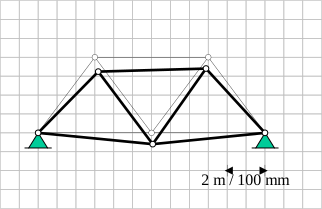
Fig. 53 Displaced structure#