

Exam Friday#
Today some studnets make an additional exam assignment covering static indeterminate structures, continuum mechanics or stability including its prerequisites. For more information about the exam see the assessment information in course information
Exam assignment 3 Statically indeterminate structures#
Your own submission and its grading will be available on  after the exam.
Given is the following structure:
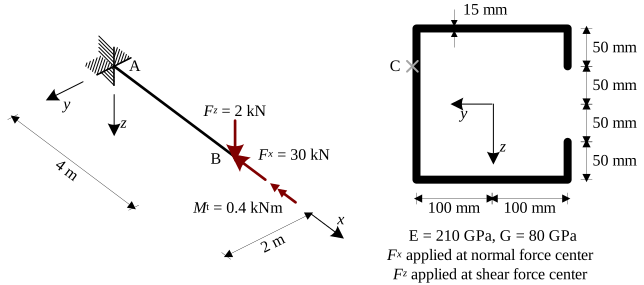
\(EA_{\rm{AC}} = 240 \, \rm{MN}\)
\(EI_{\rm{AC}} = 1200 \, \rm{MNm}^2\)
\(EA_{\rm{BC}}, EI_{\rm{BC}} \gg EA_{\rm{AC}}, EI_{\rm{AC}}\)
Fig. 241 #
Exercise
Show that this structure is statically indeterminate to the second degree.
Solution
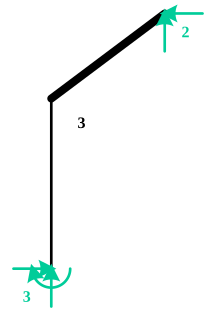
Fig. 242 #
For this structure, the external static indeterminacy is equal to the internal static indeterminacy.
There are 5 unknowns and 3 equilibrium equations, making the structure statically indeterminate to the second degree.
Exercise
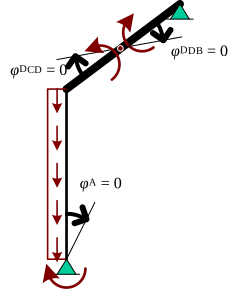
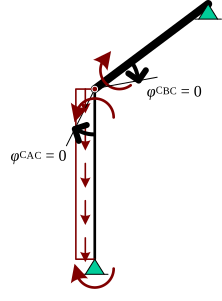
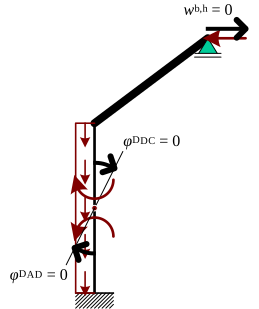
Provide three valid variants to make this structure statically determinate for the purpose of the force method. Provide three different variants: over all variants, you must have adjusted at least each node and element once. For each of the variants, provide the necessary compatibility equation(s) to determine the statically indeterminate force(s).
Exercise
Find the displacement of \(\rm{C}\) using the force method.
Solution
The following statically indeterminate structure is chosen:
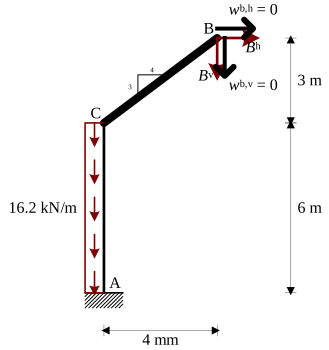
\(EA_{\rm{AC}} = 240 \, \rm{kN}\)
\(EI_{\rm{AC}} = 1200 \, \rm{kNm}^2\)
\(EA_{\rm{BC}}, EI_{\rm{BC}} \gg EA_{\rm{AC}}, EI_{\rm{AC}}\)
Fig. 246 #
First, the internal forces in \(\rm{C}\) are determined:
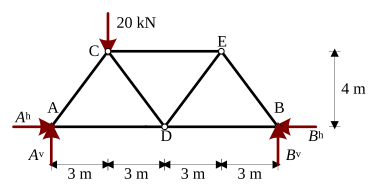
Fig. 247 #
This gives:
\(V_{\rm{C}}^{\rm{AC}} = B_{\rm{h}}\)
\(N_{\rm{C}}^{\rm{AC}} = B_{\rm{v}}\)
\(M_{\rm{C}}^{\rm{AC}} = 3 \cdot B_{\rm{h}} + 4 \cdot B_{\rm{v}}\)
Now, the displacements of node \(\rm{C}\) can be determined based on the elongation of a bar and forget-me-nots for part \(\rm{AC}\):
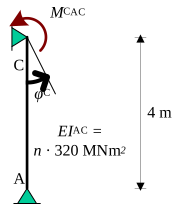
Fig. 248 #
This gives:
\(u_{\rm{C,h}} = \cfrac{21}{200} B_{\rm{h}} + \cfrac{3}{50} B_{\rm{v}}\) (→)
\(u_{\rm{C,v}} = \cfrac{1}{40} B_{\rm{v}} + \cfrac{243}{200}\) (↓)
\(\theta_{\rm{C}} = \cfrac{3}{100} B_{\rm{h}} + \cfrac{1}{50} B_{\rm{v}}\) (↻)
As \(\rm{CB}\) doesn’t deform but can rotate, this leads to:
\(u_{\rm{B,h}} = u_{\rm{C,h}} + \theta_{\rm{C}} \cdot 3 = \cfrac{39}{200} B_{\rm{h}} + \cfrac{3}{25} B_{\rm{v}}\) (→)
\(u_{\rm{B,v}} = u_{\rm{C,v}} + \theta_{\rm{C}} \cdot 4 = \cfrac{3}{25} B_{\rm{h}} + \cfrac{21}{200} B_{\rm{v}} + \cfrac{243}{200}\) (↓)
Equating the displacements of node \(\rm{B}\) to zero gives:
\(B_{\rm{h}} = 24 \, \rm{kN}\)
\(B_{\rm{v}} = - 39 \, \rm{kN}\)
This gives:
\(u_{\rm{C,h}} = 0.18 \, \rm{m}\) (→)
\(u_{\rm{C,v}} = 0.24 \, \rm{m}\) (↓)
Exercise
Draw the displaced statically indeterminate structure for which you indicate the displacements of node \(\rm{C}\) and the location of the point of inflection (the point for which the curvature changes sign).
Solution
As the bending moment in \(\rm{C}\) is \(3 \cdot B_{\rm{h}} + 4 \cdot B_{\rm{v}} = - 84 \, \rm{kNm}\) with a shear force of \(B_{\rm{h}} = 24 \, \rm{kN}\) (which equates the slope of the bending moment diagram), the bending moment is \(0\) at \(\cfrac{84}{24} = 3.5 \, \rm{m}\) to the bottom of node \(\rm{C}\), which is the point of inflection.
For a more correct representation of the deformed structure, the rotation of node \(\rm{C}\) can be taken into account, which is \(-0.06 \, \rm{rad}\) (↺).
This gives:
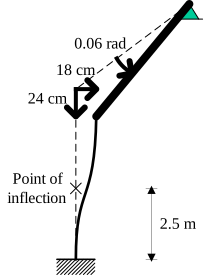
Fig. 249 #
Exam assignment 3 Continuum mechanics#
Your own submission and its grading will be available on after the exam.
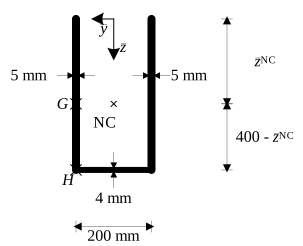
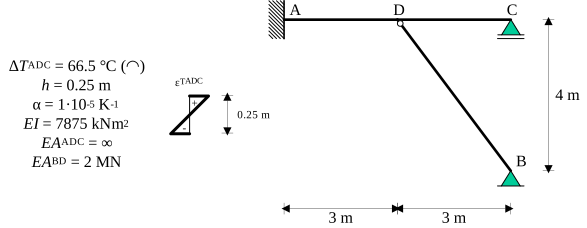
Given is the following structure:
Exercise
Show that \(A = 150 \sqrt{2} \, \rm{cm}^2\), \(\bar z_{\rm{N.C.}} = 0 \, \rm{mm}\) and \(I_{zz} = 31250 \sqrt{2} \, \rm{cm}^4\).
Solution
The area of the cross section is:
There is as much material above as below the \(y\)-axis, which gives \(\bar z_{\rm{N.C.}} = 0 \, \rm{mm}\).
The second moment of area \(I_{zz}\) is (taking into account the projected horizontal thickness of the parts):
Exercise
Show that \(V_{\rm{B}}^{\rm{SB}} = -60 \, \rm{kN}\) and \(M_{\rm{B}} = -240 \, \rm{kNm}\).
Solution
Using equilibrium equation you can find:
\( V_{\rm{B}}^{\rm{SB}} = -60 \, \rm{kN}\)
\( M_{\rm{B}} = -240 \, \rm{kNm}\)
Exercise
Determine the 3D stress tensor on a positive cross section just left of \(\rm{B}\) in point \(\rm{E}\). Indicate the directions of this stress tensor.
Solution
To find the shear stress in \(\rm{E}\), the part below \(\rm{E}\) can be seen as sliding off, this gives:
As the shear force acts upwards on a positive cross section, the shear stress acts in in top right direction in \(\rm{E}\)
The normal force can be found with:
So the 3D stress tensor is:
With the \(x\)-axis in the original \(x\)-direction, the \(z\)-axis along the edge to the bottom left and the \(y\)-axis perpendicular to the edge to the top left:
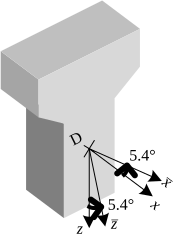
Fig. 252 #
Exercise
Determine the deviatoric stress tensor on a positive cross section just left of \(\rm{B}\) in point \(\rm{E}\). Include the direction of the coordinate system of this deviatoric stress tensor.
Solution
The principle stresses are:
\(\sigma_1 = \frac{1}{2} \cdot -67.88 - \frac{1}{2} \cdot \sqrt{ \left(-67.88 \right)^2 + 4 \cdot 4.5^2} \approx -68.18 \, \rm{MPa}\)
\(\sigma_2 = \frac{1}{2} \cdot -67.88 + \frac{1}{2} \cdot \sqrt{ \left(-67.88 \right)^2 + 4 \cdot 4.5^2} \approx 0.297 \, \rm{MPa}\)
\(\sigma_3 = 0 \, \rm{MPa}\)
This gives the isotropic stress:
This gives the deviatoric stress tensor:
This stress tensor is coordinated in the principle stress directions, which are not the same as the original stress tensor.
The coordination system of the deviatoric stress tensor is the principle stress direction. This is the original coordinate system rotated over an angle of \(\theta = \frac{1}{2} \cdot \arctan \left( \cfrac{4.5}{\frac{1}{2} \left(67.88 - 0\right)} \right) \approx 3.74^{\circ}\) around the \(y\)-axis of the 3D stress tensor in the direction from \(z\) to \(x\).